Inside Tarsco Bolted Tank Engineering: Custom Tank Design, Foundation Calculations, and Inspection
A reliable storage tank starts with engineering decisions made long before fabrication begins. Capacity is only one consideration. The design must also reflect the stored material, site conditions, foundation requirements, environmental loads, and expected operating temperature.
Tarsco Bolted Tank addresses these variables when engineering bolted tanks and silos for liquid and dry bulk storage.
Why Tarsco Bolted Tank Custom-Engineers Most Tank Systems
With the exception of the pre-engineered DiamondReady™ line, Tarsco systems are designed for individual project requirements.
Although many tanks follow established design principles, their final configurations depend on several project-specific inputs:
- Required storage capacity and dimensions
- Properties of the stored material
- Site and foundation conditions
- Wind, seismic, and snow loads
- Sealant or liner requirements
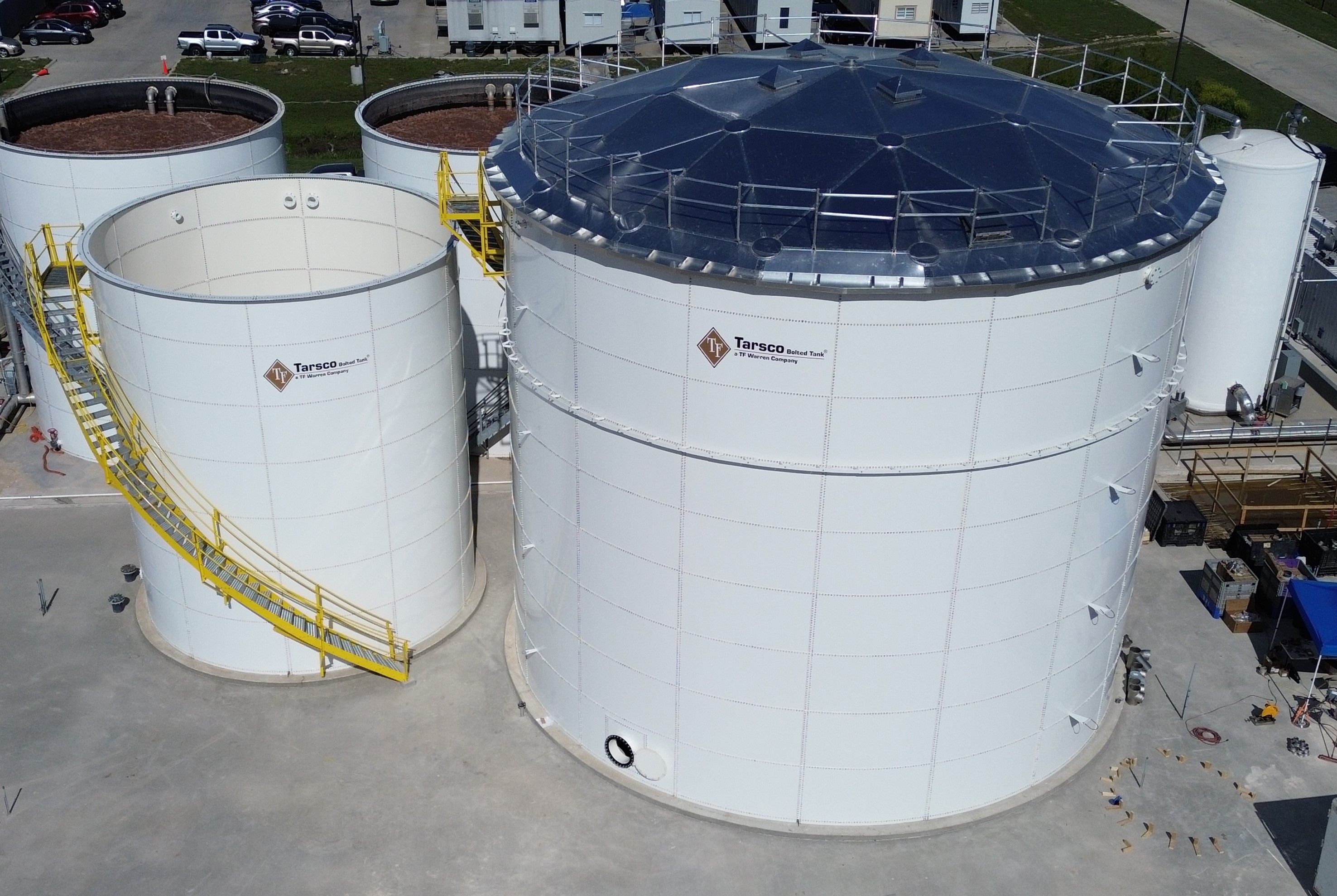
This approach allows Tarsco to adapt a proven tank system instead of forcing a standard configuration into an unsuitable application. The company’s engineering capabilities include tank designs compliant with AWWA D103, NFPA 22, and FM 4020 requirements, as well as silo designs compliant with ASME SBS.
How Tarsco Bolted Tank Uses RISA-3D for Tank and Foundation Calculations
As part of its tank engineering services, Tarsco Bolted Tank uses RISA-3D to perform tank and foundation calculations. The software supports the evaluation of structural loads and design parameters associated with each project.
Tank and foundation calculations are closely connected. The tank’s geometry, stored-product load, support conditions, and anchorage affect how forces are transferred into the foundation. Evaluating these elements together helps ensure that the tank and its supporting structure function as a coordinated system.
Tarsco’s engineering scope also includes the design of platforms, crosswalks, and other specialty structures required for access, operation, or integration with the surrounding facility.
Designing for Wind, Seismic, Snow, and Temperature Limits
Storage tanks and silos may be exposed to substantial environmental forces throughout their service lives. Tarsco’s designs account for wind, seismic, and snow loads, with the controlling conditions varying by location.
A tank in a high-wind region may require different structural and anchorage considerations from one installed in a seismic zone or an area with heavy snowfall. These forces are evaluated as part of the complete tank system.
Temperature also requires careful consideration, although the allowable range is not determined by structural steel alone. It may be limited by the sealant or, when present, the liner. These components must be compatible with both the stored material and the expected operating temperature.
For that reason, suitability across the expected temperature range should be evaluated at the system level rather than assumed from the tank structure alone.
Ringwall vs. Mat Foundations: Why Geotechnical Findings Come First
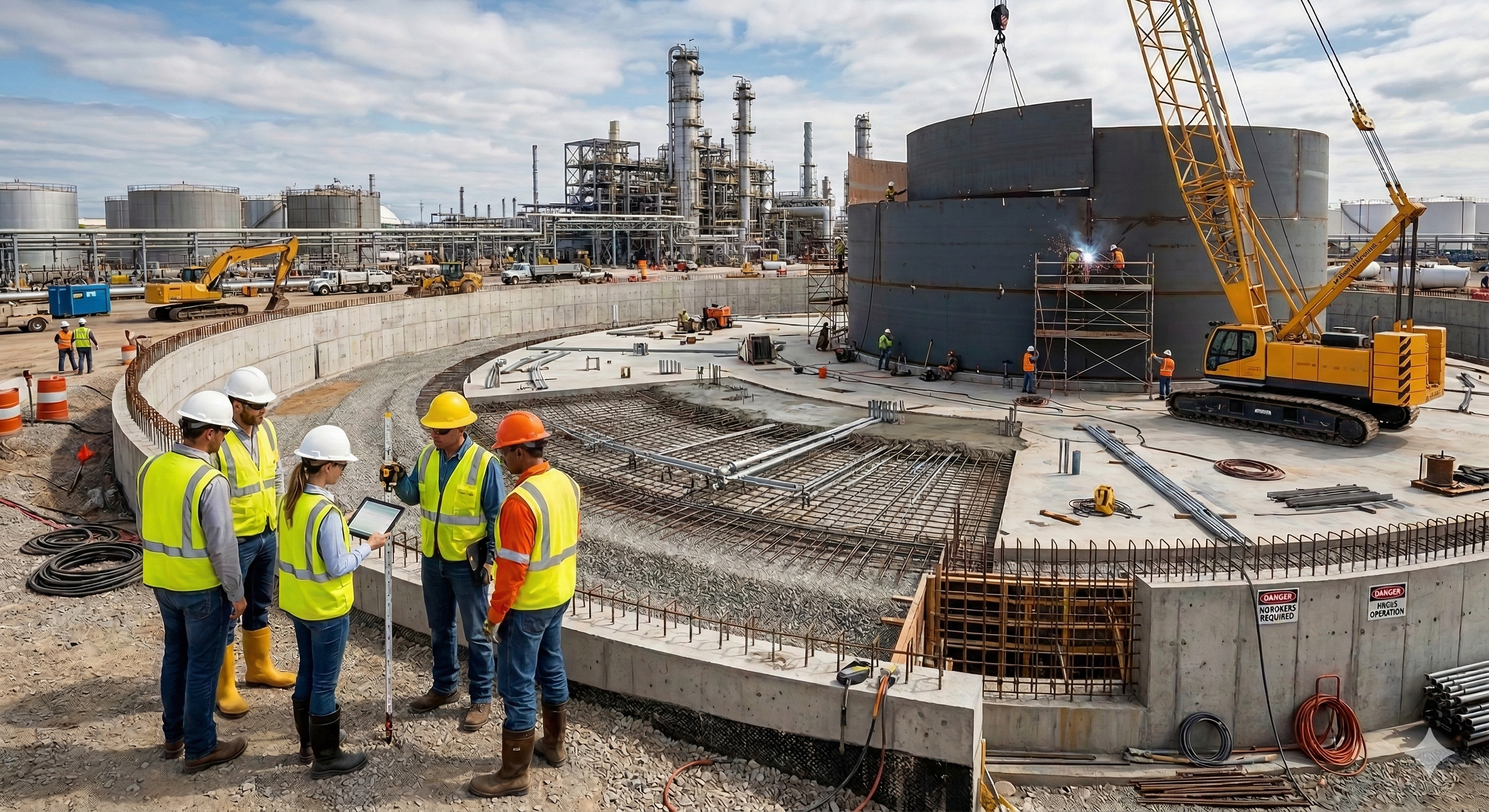
Neither a ringwall nor a mat foundation is automatically the better option based only on tank capacity or a general description of the soil. The geotechnical engineer first determines which foundation types are acceptable based on the site’s subsurface conditions and bearing capacity.
Once the technically viable options have been established, Tarsco’s tank and foundation calculations can be coordinated with those geotechnical requirements. If both ringwall and mat foundations are acceptable shallow-foundation solutions, the final choice is generally economic.
Geotechnical findings establish what the ground can support, while the engineering calculations address the loads imposed by the proposed storage system. Tarsco’s capabilities include mat, ringwall, and starter ring foundation design, with the appropriate configuration determined by the conditions of the individual site.
What Tarsco Bolted Tank Looks for When Inspecting Existing Tanks and Silos
Tarsco also provides inspection services for existing bolted tanks and silos. A typical inspection begins with a visual assessment focused on:
- Coating wear or coating loss
- Visible leakage
- Deformation
These observations help determine whether the structure requires routine maintenance or a more detailed evaluation. AWWA D103 recommends an external inspection every year and an internal inspection every three to five years.
When Visual Findings Call for Additional Testing
Not every visual finding requires advanced testing. However, evidence of material deterioration or structural movement may justify further investigation. Depending on what is observed, the next step could include a foundation survey or an assessment of the remaining material.
Tarsco’s inspection and testing capabilities include ultrasonic thickness checks. This non-destructive method can be used when the actual remaining thickness of steel components needs to be determined. It should be viewed as a targeted follow-up technique rather than a mandatory part of every routine inspection.
The purpose of additional testing is to provide reliable information for a practical engineering decision – whether to continue monitoring the tank, perform maintenance, repair an affected area, or develop a retrofit.
Six 5,000-Ton Tarsco Bolted Tank Silos for Twin Eagle Sand Logistics
Tarsco’s work with The Mouat Company on the Twin Eagle Sand Logistics facility shows how bolted silos can be integrated into a large material-handling operation.
Key project details include:
- A 30,000-ton transload facility in Big Spring, Texas
- Six Tarsco bolted silos with a capacity of 5,000 tons each
- Two truck scales, each serving three silos
- A location selected to serve the Permian Basin
The project also involved substantial below-ground construction. According to Mouat’s announcement, the facility used deep foundations with 20 piles beneath each silo, extending 56 feet. Combined with the six 5,000-ton Tarsco bolted silos, the project illustrates how large-scale storage installations bring together tank engineering, site conditions, foundation requirements, and broader material-handling infrastructure.
Bringing Tank Design, Foundations, and Inspection Together
Tarsco’s engineering scope extends beyond the tank shell. It brings together code-compliant tank and silo design, site-appropriate foundations, and the platforms, crosswalks, and specialty structures needed to integrate a storage system into the surrounding facility. The same engineering perspective supports inspections of existing bolted tanks and silos, helping owners make informed maintenance, repair, and retrofit decisions.
By combining recognized design requirements, including AWWA D103, NFPA 22, FM 4020, and ASME SBS, with project-specific calculations and site data, Tarsco Bolted Tank can address both the immediate design requirements and the long-term performance of the complete storage system.
About the author

Energetic and dedicated Operations Leader with more than 20 years of demonstrated results driven experience in fast paced manufacturing environments. Proven skills in building and directing strong teams to achieve challenging objectives.
View all postsRecent Posts
How to Perform an Oil Tank Inspection: What to Review
How to Keep a Water Tank From Freezing: Tank Planning Guide
Choosing the Right Dry Bulk Storage Tank: 6 Key Questions
Grain Storage After Harvest: Control Moisture, Temperature & Airflow